


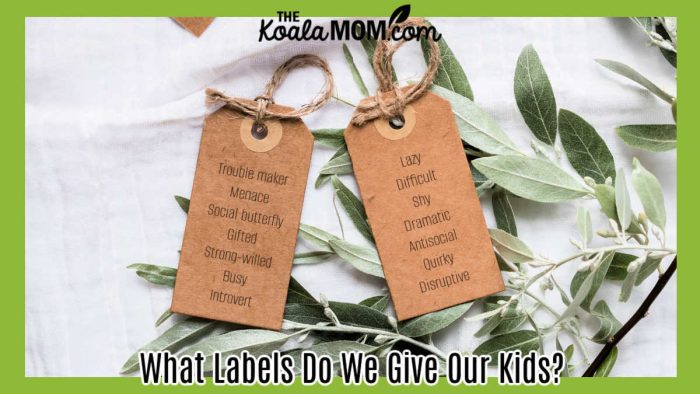
Trouble maker. Menace. Social butterfly. Antisocial. Strong-willed. Busy. Shy. Bully. Introvert.
These are some of the labels my kids have been given over the years. Some came from teachers, friends, or strangers. Others came from me. Everyone labels children. The question isn’t whether we label kids—it’s what labels we’re using. Some of those labels are positive, and some are negative; some are helpful, and some are not.
This post contains affiliate links; as an Amazon associate, I earn from qualifying purchases.
I Don’t Want My Child Labeled
When I began pursuing neurodivergent assessments for my children, I often heard parents say, “I don’t want my child to be labeled.” I understood the concern. None of us wants our child to be reduced to a diagnosis. But as I watched my children struggle, I realized something important: they were already being labeled. The real question wasn’t whether they would have labels—it was whether those labels would accurately reflect who they were and what they needed.
When the noise and sensory input overwhelmed my son after a jiu jitsu class and he bit another child, he was labeled a menace. When he couldn’t wait quietly in line, he was labeled disruptive. When anxiety made him desperately seek control in a situation that felt overwhelming, he was labeled aggressive.
My son was going to be labeled either way. The only question was whether the labels would tell the truth.
Labels like “menace” and “trouble maker” didn’t help anyone understand him. They described how his behaviour affected other people, but said nothing about what was happening inside him.
My son wasn’t being difficult because he enjoyed making life hard for everyone around him. Quite the opposite; I knew he was a good kid at heart and these “difficult behaviors” reflected his own difficulties. He struggled with impulsivity, emotional regulation, executive functioning, sensory processing, and social communication. Calling him a troublemaker didn’t explain his behaviour—it explained other people’s frustration at the way his struggles affected them.
My daughter wasn’t antisocial. She was spending enormous amounts of energy masking in social situations and needed time afterward to recover. Calling her shy ended the conversation. Understanding that she was masking invited us to ask a better question: what did she need in order to feel safe and comfortable? How could I create social situations for her where she didn’t feel overwhelmed and exhausted?
That, I’ve realized, is the difference between a label and understanding. A label often stops our curiosity. We think we’ve figured the child out. Understanding keeps us asking questions. Why is this happening? What is this child experiencing? What support would help them thrive?
Labels Shape Identity
The labels we choose don’t just shape what we think about our children. They shape what our children think about themselves. Children become the stories they hear about themselves. I still remember some of the labels I carried as a child. They reduced me to one small part of who I was, and for years I struggled to see beyond them.
I don’t want my son to internalize labels like “troublemaker” or “menace.” Instead, I’ve spent years trying to translate his behavior for the adults around him. When others saw aggression, I tried to explain overwhelm. When they saw disruption, I explained impulsivity. When they saw a child who couldn’t follow expectations, I explained a brain that was working much harder than anyone realized. I wanted the adults in his life to respond with understanding rather than assumptions, because I knew my son was listening to the stories they told about him.
That’s why the words we choose matter so much. In her book Quirky Catholic Kids, mom and author Ginny Kochis writes that parents get to help shape the way our children understand themselves:
As quirky kid parents, we have the unique opportunity to set a firm foundation for the self-concept they develop as kids, re-structure as teens, and carry into adulthood. The way we approach our children’s gifts, talents and neurodivergence helps root their identity in Christ. If we label their stimming as disruptive, they’re going to wrestle with shame each time their bodies need to move. Where ADHD is concerned, if we only hound them for their inattention, they’re more likely to brand themselves as lazy. If a child experiences pathological demand avoidance, where responding to instruction causes a fight or flight response, labeling a child as defiant or rude overshadows the root cause of the behaviour: anxiety. As I tell my kids, our words and actions have meaning. As our children’s influencers, our words and actions should mean something good.
Diagnosis Invites Understanding
This is the crucial difference between a diagnosis and a label. As Kochis goes on to explain, “A diagnosis and a label are two different things. Labels are arbitrarily assigned, negative descriptors based on appearances and stereotypes. Lazy is a label. So are stupid and shy. A diagnosis, on the other hand, is assigned after evaluation and testing. Where a label is a sentence, diagnosis is a tool.”
Labels often end our curiosity. Once we’ve decided a child is lazy, rude, defiant, or disruptive, we stop asking questions. We think we’ve explained the behavior. A diagnosis does the opposite. It invites us to ask more questions: Why is this happening? What is this child experiencing? What supports would help? Instead of closing the conversation, it opens it.
A diagnosis says:
- here’s why this happens
- here’s what helps
- here’s what doesn’t help
- here’s what strengths often accompany these struggles
- here’s where to find support
A diagnosis is based on hard questions and time spent carefully considering all the different strengths and weaknesses of a child. The diagnosis provides greater understanding of the child. When my son was given his ADHD diagnosis, and again when he was given his autism diagnosis, I was asked if I had any questions. No, I didn’t; by the time those diagnoses arrived, I’d already done so much research and asked so many questions that the diagnoses were not surprises.
The diagnoses didn’t tell me anything I hadn’t already begun to suspect. What they gave me was language. They explained what I had been seeing for years, and they opened doors to supports, accommodations, and resources that I couldn’t access before. The diagnoses made it easier to explain my son’s struggles to those around him and to advocate for what he needed.
As Kochis says, “You now have a tool, one that helps you learn about your child’s brain and opens the doors to living life to its fullest. Unlike a label’s negative impact on your child’s self-concept, a diagnosis helps your child thrive.”
Diagnosis changed the questions I asked. Instead of asking, “What’s wrong with this kid?” I began asking, “What is making this hard?”
Instead of asking, “Why won’t they behave?” I asked, “What is their brain trying to communicate?”
Those questions didn’t excuse every behavior, but they helped me respond with curiosity instead of frustration, compassion instead of condemnation, and support instead of shame.
What Diagnosis Changed for My Family
For the past four years, I have fought for diagnosis for first one child, and then several others, and then for myself. Before we got the diagnoses, I felt as if I was shooting in the dark, trying to explain how I saw them struggling and trying to find help but not really being understood or heard. This was especially true in the case of my older children, who have found ways to mask and compensate and hide some of their neurodiverse traits (just as I did myself).
Getting the diagnoses didn’t change my kids (or me). It meant that I understood them (and myself) differently. Schools understood him. Professionals understood him. Now, with a diagnosis, I had language. I had supports. I had community. I had direction.
A diagnosis isn’t only about understanding my kids better. It also opens doors. For example, at school, thanks to my son’s ADHD diagnosis, instead of punishment, the teacher could provide:
- movement breaks
- noise-canceling headphones
- visual schedules
- extra processing time
- occupational therapy
- speech therapy
- executive functioning supports
In some places, a diagnosis can provide more concrete support in the form of funding. Here in BC, children with autism have long had government funding to provide additional supports both at home and at school. Currently, the BC government is updating this funding to better meet the needs of more children, including (hopefully) those with ADHD and other diagnoses besides autism.
How Do We Describe Our Kids?
Of course, diagnoses can also be misused. Sometimes people assume a diagnosis defines everything about a child or limits what they can achieve. That is a real danger. Stereotypes are generic labels about ADHD, autism and other traits that often do more harm than good, because each child with a diagnosis is unique and different. Even within my family, with four ADHD diagnoses, we do not all exhibit our ADHD in the same way. But the solution isn’t avoiding diagnosis altogether. The solution is remembering that a diagnosis describes how a child’s brain works—not the limits of their potential.
Every child will be described somehow. They’ll be called busy, lazy, shy, difficult, dramatic, gifted, quirky, or disruptive. Those labels will shape how others see them—and eventually how they see themselves.
A diagnosis doesn’t replace your child’s identity. It protects it. Instead of reducing a child to other people’s assumptions, it offers a deeper understanding of who they are, how they experience the world, and what they need to thrive.
Some resources that have helped me in understanding my children rather than labeling them include:
- ADHD is Awesome: A Guide To (Mostly) Thriving With ADHD
- Autistic Logistics, Second Edition: A Parent’s Guide to Tackling Bedtime, Toilet Training, Meltdowns, Hitting, and Other Everyday Challenges
- Beyond Behaviors: Using Brain Science and Compassion to Understand and Solve Children’s Behavioral Challenges
- The Explosive Child: A New Approach to Understanding and Parenting Children
No Responses Yet