


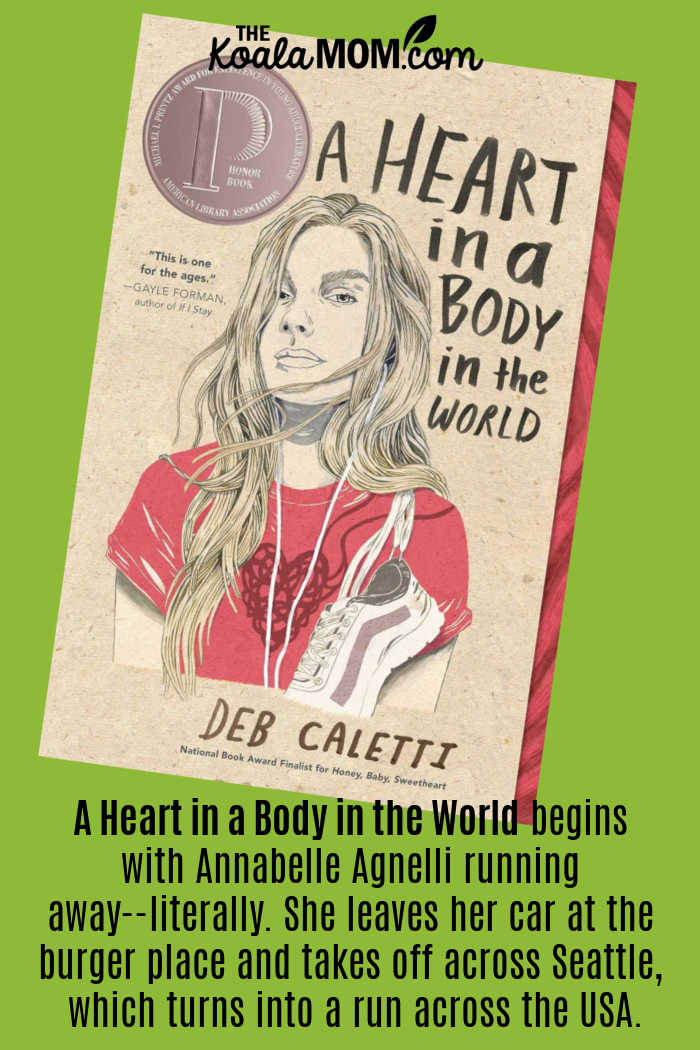
Recently, I took a break from reading 19th century novels and feminist theology to pick up a young adult novel that someone in my inbox recommended. A Heart in a Body in the World begins with Annabelle Agnelli running away–literally. She leaves her car at a burger place and takes off across Seattle, which turns into a run across the USA.
Followed by her grandpa in his RV, and supported from Seattle by her brother (who packs her running gear on the night she runs away) and her school mates (who set up a GoFundMe account and publicity for her), Annabelle runs. Through summer heat and thunderstorms, through small towns and Hutterite colonies and national parks, she puts in 16 km per day. And while she runs along American roads and highways to Washington, DC, the memories run through her head.
I found this book at my local library; all opinions expressed are my own. This post contains affiliate links; as an Amazon associate, I earn from qualifying purchases.
Annabelle turns 18 on the road and misses her high school graduation. She makes new friends, talks on the phone with old friends, and sees more of the USA than most Americans. As she runs, she confronts some big questions about life, about trauma, about pain and grief, about love. While I appreciated Caletti’s descriptions of the external world Annabelle passes through, I appreciated even more her descriptions of Annabelle’s internal world.
It is what it is, Annabelle tells herself. It’s a phrase she often finds comforting. It reminds her to accept the truth rather than struggle against it. But now, it sort of pisses her off. Sometimes, what is is something that shouldn’t be. It should never have been. It only is because of messed-up reasons going back messed-up generations, old reasons, reasons that don’t jibe with this world today. Sometimes, an is should have been gone long, long ago, and needs to be–immediately and forcefully and with not a minute to lose–changed.
Being a Girl in Today’s World
One thing Annabelle struggles with is what it’s like to be a young woman today. She is the “good girl,” the careful girl, the girl with the mother who warns her about everything, who follows the rules, and still she gets hurt.
As a girl, too, she was told that she needed to be on guard against 50 percent of the human race, and she carried that awareness everywhere, ready to make use of it every time a car slowed next to her as she was walking, or she was driven home by the dad after babysitting. Every time she waited at a bus stop or was at a party with boys and alcohol or was just plain alone, she felt the high alert of vigilance. … But what are you supposed to do when you’re also required to be kind and helpful as well as vigilant? To give directions to the driver in the car slowing beside you, to be polite to the kids you babysit, to be friendly and fun at the party?
This dichotomy is, in many ways, the driving force of A Heart in a Body in the World. The entire reason for Annabelle’s trauma, her guilt, her run. As Annabelle wrestles with this facet of being a young woman in today’s culture, I saw in her story my own story–and the story of too many other young women in our society, bearing a load of guilt we shouldn’t have to carry. Because Annabelle was friendly and nice to the wrong person, because society expected this of her, tragedy ensued.
As women, many of us were taught to ignore our inner voices, to distrust our bodies, to silence ourselves. Society’s expectations of what women should be are imprinted on us from a very young age. Unfortunately, those very expectations can be dangerous, can leave us dealing with as much trauma as Annabelle. One way we find healing is to let go of those expectations and listen to ourselves, as Annabelle’s mom Gina tells her:
“You have to follow your instinct. Listen to the voice inside. … Here’s where it speaks.” Gina puts her hand on her chest. “Something is bothering you, you listen. Good stuff doesn’t nag at you. You feel nervous in a parking lot, you get out of there. You feel uneasy at a party? You fucking leave.”
What Trauma and PTSD Look Like
Annabelle’s mental, emotional and physical struggles show the effect of a huge, traumatic event and what PTSD may look like. For much of her run, she reminds herself of things she’s learned from her therapist (even if she has trouble believing or applying those things). She tries to stop her whirling thoughts, taps her fingers when she’s nervous, runs blindly as her memories take her back again.
Just for a second, she imagines it–letting go. Handing the heavy stuff back to the people it belongs to. When she does, she gets the most peaceful feeling, as if there’s a cool and reassuring hand on her forehead. She is safe and okay and the storm is out there somewhere, but not here.
Towards the end of her run, she resumes online appointments with her therapist. Healing is a journey, like her run across the USA, small steps towards her goal, but “healing” is not a destination like Washington, DC–it is a lifelong journey. There are people in Annabelle’s life who think her journey should go faster or look different. She also has people in her life who support her where she is, running both away from the trauma and towards something bigger.
A Healthy Relationship
One thing I loved about A Heart in a Body in the World was Annabelle’s growing friendship with Luke. Her past trauma causes her to put up walls with him initially, but slowly, she opens up to him. She and Luke find out things they have in common (books) and he supports her from a distance, without ever pushing her. Eventually, he tells her he likes her but also says, “I mean, after what you’ve been through, Jesus, I’d be a dick if I didn’t understand we need to go slow as hell here, right?”
That line is absolute gold. Luke knew what Annabelle’s trauma was from the beginning of their relationship, but he gave her the space she needed for her run, for her healing, for herself. He was there when she needed him but also willing to recognize that because of her trauma, she wasn’t ready for a new relationship yet. And when he shares this with Annabelle, she’s done enough healing that she’s able to hear it:
She checks in with herself, as Dr. Mann has suggested. It feels calm in there. It feels calm and even accepting. Her palms are a little sweaty, and her heart is beating a bit fast, but it’s just her and Luke here, and everything’s okay. Slow as hell means time to breathe and think and say what she needs to say. Slow as hell is a capsule of respect for her boundaries. Respect for her boundaries equals safety.
Respect. Boundaries. Safety. Those are words every woman should learn. All of us deserve respect and safety and all of us should be given space to set boundaries that ensure we feel safe and respected. Depending on our past traumas, those boundaries may look different for each of us, but we need a society that recognizes boundaries are okay, safety is necessary, and respect is owed to each person.
The Problem of Violence
A Heart in a Body in the World raises the question of violence and how we deal with it. Through Annabelle’s run across the USA, we see the very personal effects of a violent tragedy upon one young woman and her friend group and even everyone who hears about the tragedy. In a speech near the end of her run, Annabelle addresses the core of violence:
What the shooter really wanted was to control me. I understand that. He wanted to shut me up. … When I think about it in the simplest way I can, I see that his violence was just a show of power by a bully. Maybe all violence is. But it works. It sure does. Violence shuts you up, all right.
This is exactly what most women today have dealt with, at one time or another in our lives, some more than others: a show of power by a bully. Maybe our bullies didn’t pull guns on us. Maybe they didn’t even throw punches at us. But the core of violence is a desire to control another human being. This is what we see in Trump, telling a female reporter to shut up. This is what we see in domestic violence, sexual assault, post-separation abuse, school shootings, and so many other tragic incidences that make the news (or don’t).
Unfortunately, for Annabelle and many other victims who suffer from another person’s desire to control them, the violence isn’t the end. We are re-traumatized and re-abused by those who should have protected us and didn’t. At one point in her story, Annabelle has to grapple with the fact that she did go to some adults in her life with her concerns for how the Taker was treating her. She trusted those adults were dealing with the problem. Unfortunately, her trust was misplaced. Those adults didn’t recognize the seriousness of the situation and didn’t prevent the tragedy that sent Annabelle on her run across the USA.
I just keep running on those hot roads because I don’t know if my country will protect me and my rights, as a female, as a person who wants to be free from violence. It has not shown me that it will protect me, from males more powerful than me, from people who hate and intend to do harm. It has show me that I am less than, that I am not worth being protected. It has shown recklessness with my well-being. So I run in the heat and and I sweat and I push myself to persevere.
And I run and run because I am filled with grief and sorrow, too. My running is crying and praying and screaming. It is saying that I don’t know what to do but I must do something. That I must use my voice, because it’s the only thing you have sometimes when someone or something is larger and more powerful than you. My voice is here now, but it is mostly there in my running body. It is saying please and it is saying must. Please see my grief and sorrow. Must end this grief and sorrow.
At the end of the story, Annabelle has to relive her trauma in court. Our legal system requires victims to face their abusers and to go through the trauma all over again. In Annabelle’s case, the Taker faced severe consequences for his actions. She was given closure on that event. Too many other victims are not. Their stories are brushed off as “alleged,” or they are told they don’t have enough evidence, or “it wasn’t that bad,” or given other excuses for why their cries for justice are unheard.
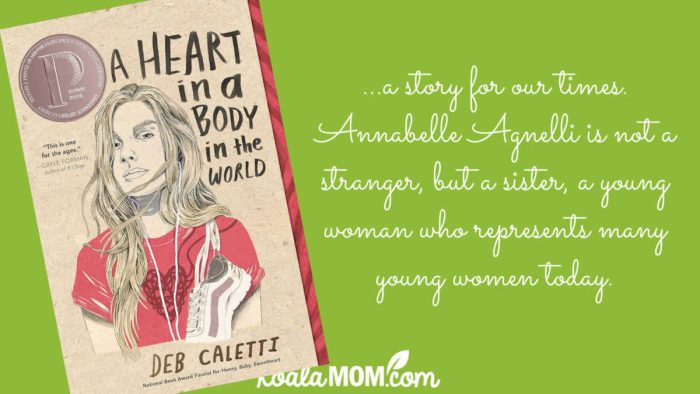
A Heart in a Body in a World is a story for our times. Annabelle Agnelli is not a stranger, but a sister, a young woman who represents many young women today. While her run may be fictional, the issues she faced are frighteningly real. May Annabelle inspire each of us to stand up for justice, to demand respect, to listen to our inner voices, and to set boundaries to ensure our safety.
No Responses Yet