
)
)
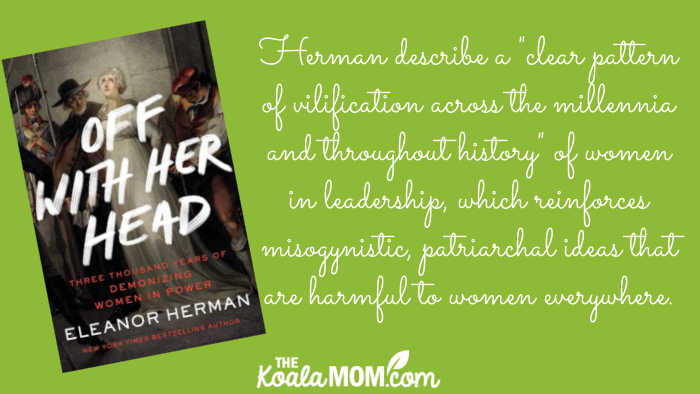
The bright white letters on the orange spine on the library’s discard shelf caught my eye: Off with Her Head: Three Thousand Years of Demonizing Women in Power by Eleanor Herman. I scanned the book quickly and then paid the twooney to buy it. I enjoy historical biographies, but the theme also intrigued me. It seemed like a synthesis of posts that have floated past on my social media feed, decrying the ongoing discrimination women still face in today’s “gender-equal” world.

This post contains affiliate links; as an Amazon associate, I earn from qualifying purchases.
An overview of Off With Her Head
In the introduction, Herman explains that this topic came up for her when she read a biography of Cleopatra that reminded her of a more modern woman: “I noticed that in Cleopatra’s rise and fall, the story of her power and Rome’s horror that a woman should wield it, there were uncanny similarities with Hillary Clinton’s trajectory through the 2016 election and beyond.” Surely, we would think, we of the enlightened twenty-first century treat women better than Egyptians and Romans did in the first century?
However, as Herman finds, women who wish to be leaders are treated no differently now than they were two thousands years ago: “In each woman’s story, I discovered organized smear operations churning out unfounded accusations of sexual improprieties and criticisms of her ambitions, untrustworthiness, appearance, and unlikeability, accusations rarely made against male leaders either in the first century BCE or today.”
Herman coins the term Misogynist’s Handbook to describe this “clear pattern of vilification across the millennia and throughout history” of women in leadership, which reinforces the Patriarchy. She notes that this Handbook has been used to keep women in line for centuries, in varying degrees. For example, Egyptian women had some rights, while Athenian women did not. While she focuses on Western culture in her book, similar anti-women trends happened in Eastern cultures as well. Herman questions where this misogyny comes from, but says it needs to go.
Herman also points out that misogyny and patriarchy have continued because few people examine it: “Most of us who enforce the handbook, support it, and obey it unquestioningly are not bad people. Most of us are probably very good people. We merely continue the traditions we learned from infancy on, as our parents did, and theirs, going back thousands of years. Most of us certainly didn’t mean to harm anyone. Indeed, many of those being harmed are blissfully unaware of it. The millennia-long triumph of misogyny is largely due to its invisibility.”
I can imagine many people saying, “Can’t I criticize a female leader without being accused of misogyny?” Well, that depends on the criticism. Herman explains a useful tool for determining whether the criticism is valid or not: is the criticism directed at her actions, experience, and speeches or is the criticism directed at her appearance, voice, and personal relationships? Another tool is to flip the gender: would you direct that criticism at a man? For example, Herman provides many examples of times women running for office were told, “She should smile a lot more.” Somehow, we never hear, “He should smile a lot more.”
Women are a majority of the population, but they are treated like a minority group. The prejudice against them is so widespread that, paradoxically, most persons do not yet realize it exists. Indeed, most women do not realize it. They even accept being paid less for doing the same work as a man. They are as quick as any male to condemn a woman who ventures outside the limits of the role men have assigned to females: that of toy and drudge. ~ Shirley Chisholm, first black female presidential candidate in the US, quoted in Off with Her Head
An Investigation of Misogyny
Herman investigates the root of misogyny, looking at the origin stories of various cultures. Both Christianity and ancient Greece (the pillars of our modern Western culture) attribute all the evils of the world to women: Eve and Pandora. From there, Herman traces the ways “the same story line of blame the woman runs not only through myth and legend, but also through history.” Delilah, Jezebel, Bathsheba and other women are blamed in the Bible; Helen of Troy, Cleopatra, Anne Boleyn, Wallis Warfield Simpson and other women are blamed in history. She calls out the misogyny of various Christian leaders from St. Paul to John Knox and John Calvin.
Over and over again, Herman looks for any historical background to the accusations thrown at powerful women throughout history and comes up with nothing. She also points out how often the histories of particular women, including Cleopatra and Anne Boleyn, were written by men who hated them. If all we know about certain women comes from their enemies, then we have a very skewed view of those women – and we need to rethink the histories we are repeating. Unfortunately, most of history is written by men, and most of it is very negative towards women in leadership, even when there is no historical proof for the allegations leveled against these women. Herman concludes, “The notorious legacies of most powerful women both ancient and modern are simply not deserved.”
Most of Herman’s book delves into the “chapters” of the Misogynist’s Handbook, the things that women are criticized for:
- her ambition (“the Patriarchy sees a woman’s ambition to venture beyond that culturally assigned place as dangerous, jeopardizing society as we know it, something to be stopped in its tracks.”)
- her hair (“It is a lesson many modern female politicians have learned: no matter what you do with your appearance, no matter whom you try to please, you will be harshly criticized.”)
- her hormones (“The myths surrounding menstruation–and its evil twin, menopause–have plagued women for thousands of years and show little sign of letting up.”)
- her voice (“For thousands of years, women’s voices have been perceived as irritating in some way, usually because they are considered ‘shrill.'”)
- her mysterious unlikeability (“‘Everything you do is judged at the highest possible scrutiny so people can validate their own sense of discomfort that you’re there’.” Kim Campbell, first female prime minister of Canada)
- her family (“While we can understand the urgency for monarchs of centuries ago to marry and have children, it is almost inexplicable that almost five hundred years later, female politicians–whose heirs will not inherit the throne or prevent dynastic war–are also expected to.”)
- her sexuality (“The purpose of slut-shaming is to silence women and usually has nothing to do with their actual sexual behavior.”)
Women also get accused of being a witch or other monster, bitch or other animal, or murderer. And if all those tools fail to meet the misogynist’s needs, then they have more, including mispronouncing her name, denying her her proper title, calling her by her first name, comparing her to a doll, focusing on her body parts, making it impossible for her to work if she has young children, and more. While some of these things may seem hardly worth mentioning, when put together, they reveal a dark, disturbing pattern of how women are consistently treated as second-rate to men (especially when the ways that women are treated is compared with their male peers, as Herman often shows).
Herman spends another chapter delving into the intersection between misogyny and racism, and how history treats women who are also black. This chapter reminded me of Hidden Figures, which highlights the story of the women who worked at NASA. I wish I could say Herman’s research is the work of a jaded woman who wants to spite men. Unfortunately, I’ve seen too many similar examples on my own, both in my own work as a history buff, and in my favorite books and movies, to believe anything she says is stretching the truth.
Why Does This Matter?
Some of us may look at this and think, “Okay, so what that Cleopatra and Anne Boleyn and Hillary Clinton are treated that way.” However, Herman’s final chapters show the deep, dark side of all the misogyny she’s laid out. First, this attitude leads to actual violence against women. Second, this attitude doesn’t just affect women in leadership.
Herman’s second last chapter looks at actual consequences of misogyny for women: “When the Misogynist’s Handbook marches relentlessly forward unimpeded over an inconvenient woman who refuses to sink back into her place, the result can be death.” Anne Boleyn, Mary, Queen of Scots, and Marie Antoinette literally lost their heads for being strong female leaders. Other “troublesome” women, such as Cleopatra, died in other ways. Modern female politicians also death threats and conspiracy plots and have even been assassinated.
Herman does raise the question of whether the violence is gender-based: “We must also examine whether there is a huge difference in the kinds of threats being aimed at men and women.” She provides an example of two party leaders in Bavaria; the woman says 20 percent of her emails are abusive, often threatening rape, while her male counterpart simply gets messages calling him a communist. She gets violent threats; he gets called names. The way people talk matters, because actions often follow.
The way women who seek positions of leadership are treated matters even to those of us who don’t want leadership, because we follow our leaders. If the male leaders of our countries are treating the female leaders they work beside with contempt, disrespect, and outright misogyny, then how can any other woman expect to be treated better? We have signs in grocery stores and banks stating that harassment and intimidation will not be tolerated, and yet every day, a woman on TV or in office or at a corporate meeting is being harassed and intimidated and nothing is being done to protect her. What do we believe – the sign in the grocery store or what happens in real life in front of us?
Change Needs to Happen
Off With Her Head made me very angry. There were times when I could only read a chapter and then had to put the book down and go read Jane Austen or Richard Wagamese. As a woman, as a mother of four amazing daughters, I want better. It is not okay that my friends, my daughters and I are treated as second-best simply because our biology is different than a man’s. Misogyny and patriarchy are hurting everyone in our world today and they need to end.
Herman asks, “What would the world look like if misogyny was consigned to the garbage bin of history?” Can we even picture such a world?
“It would be a radically different place. Imagine if the Fortune 500 companies had 250 female CEOs. Or the US Congress with 50 percent women. What legislation would be prioritized? Bills regarding childcare, healthcare, the struggles of working women? We would start hearing from families about what mattered… Imagine if our hope for girls and boys was the same.” ~ Francesca Donner, former gender director of the New York Times
I’ve mentioned social media has brought this issue to my attention. Unfortunately, social media has also been used by misogynists to spread lies and ugliness about women. Herman says, “One way to at least curtail the abomination is to force social media platforms to prevent the rapid proliferation of false and sexist information about women politicians” or about any other woman. Herman wrote Off With Her Head before the current explosion of AI, with its undressing of women and children. However, viewing that controversy through the lens of Herman’s information, I see very plainly the misogyny of the men who wrote the AI – and the men who refuse to do anything about it.
Namibian first lady Monica Geingos is one woman who is fighting back: “I will not be silenced anymore… If I allow myself to be silenced, bullied, and insulted, I may be signalling that this conduct is okay, that it’s normal… It’s not okay, it’s not normal.” She’s right. We all need to follow her example, to call out the sexism, racism, misogyny, gender bias, and patriarchal ideologies that push women down. Geingos’ words make me think of Jasmine’s song in the live-action Aladdin movie (why didn’t they simply call it Jasmine so we wouldn’t have specify which movie we’re talking about?). Like Geingos, Jasmine faces a choice between being silent and complicit or standing up for herself, and I love her strength and power in choosing not be silenced.
Denmark prime minister Helle Thorning-Schmidt adds, “If bad behaviour doesn’t have a consequence, then it becomes a lesson to anyone who wants to behave badly that they can just carry on with impunity. So I think that there comes a time when enough is enough.” I heartily agree with her, and I think we’ve seen this over and over again in the news recently. Men’s bad behavior is rewarded with videos, articles, jokes on news outlets and social media. Men often face no consequences for their misogynistic attitudes or actions. And this isn’t staying at the leadership level: it trickles down in society. One of my daughters has dealt with gendered slurs at her school, because even the grade 7/8 boys have seen that this is okay (but it is not).
Let’s build a better world for our daughters.
No Responses Yet